
March 2026
The Three Systems
Why most organizations struggle is not a people problem, but a system problem — and how businesses evolve from heroics to true operational leverage.
In the 1980s and 90s, millions of Americans tuned in each week to watch MacGyver save the day using nothing but duct tape, a paperclip, and whatever random objects happened to be nearby.
It was entertaining. It was clever. And in many small and mid-market companies, it is also everyday reality.
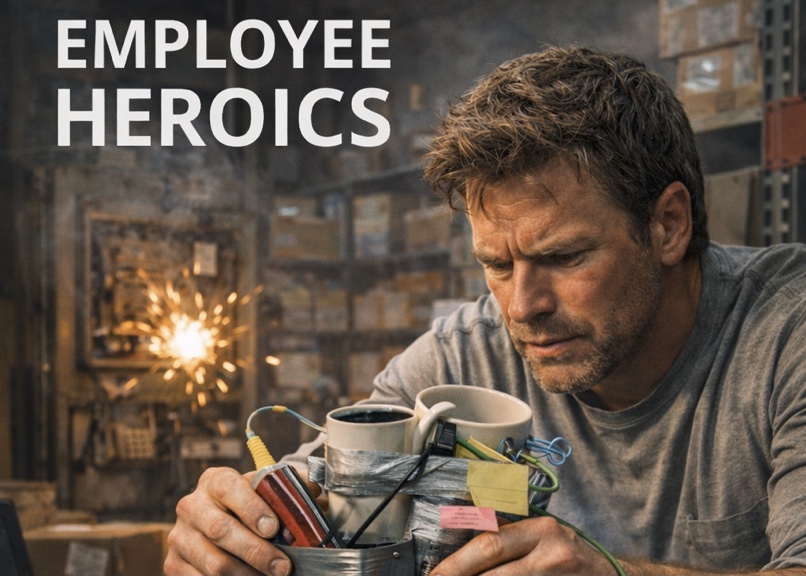
Inside these organizations, employees perform small miracles daily. They fix broken processes, manually reconcile systems that do not talk to each other, and hold entire workflows together through experience and sheer determination.
A colleague once said: Give the right person the wrong tools and they will still get the job done. It was meant as praise — and in many ways it is. But it also reveals something important.
Because if the right person can accomplish that much with the wrong tools, imagine what they could do with the right environment.
Not necessarily perfect tools. Not massive technology investments. But something much more powerful: clear systems, clear communication, and processes that support the people doing the work.
The return on investment from those improvements can often be calculated. The return on sleep is harder to measure.
Leadership conversations often focus on talent — who should be hired, promoted, or replaced. But before deciding who should be on the bus, it is worth asking a different question: what condition is the bus in?
Because in many organizations, employees are not failing — they are compensating. Compensating for unclear processes. Compensating for disconnected tools. Compensating for communication gaps between departments.
And when talented people spend most of their time compensating for systems, something predictable happens. Heroics become normal.
At Hypora, we often see organizations operating at one of three levels.
Level 1: The Heroic Organization.
In heroic organizations, success depends heavily on individuals. Operational knowledge lives inside the heads of experienced employees. Problems are solved quickly because the right person knows exactly what to do.
This environment can feel exciting. Decisions happen fast. Customers get answers quickly. Employees feel important because they are essential.
But there is a hidden cost.
When those employees take vacation, everything slows down. When new employees join, learning becomes difficult. And as the company grows, complexity increases faster than the organization can manage.
Level 2: The Disciplined Organization.
Leadership recognizes that growth requires structure. Processes begin to form. Systems are implemented. Reporting improves.
On paper, the organization becomes more professional. But something subtle often happens — momentum slows.
The feedback loop between problem and solution gets longer. Employees begin to say things like: We need more people before we can grow. That is just how the system works. It is what it is.
This is the most dangerous stage for many small and mid-market companies.
Because the organization has become structured enough to lose its speed, but not yet structured enough to unlock scale.
And an odd dynamic can emerge — as growth slows, information becomes power. Some employees begin holding onto knowledge rather than sharing it.
Level 3: The Empowered Organization.
In the final stage, capable people, clear systems, and appropriate tools begin reinforcing one another.
Employees understand their roles. Processes guide routine work. Technology supports the system instead of complicating it.
The heroes are no longer repairing broken processes. They are developing others, expanding their impact, and focusing on higher-value work.
Decision-making becomes more distributed. Ideas move faster. Leadership shifts from managing operations to shaping the future.
The organization gains momentum.
The transition from Level 2 to Level 3 is rarely a technical challenge. It is a leadership challenge.
Executives who built the company through personal effort must learn to step back. Leaders who once solved every problem must allow systems to solve them instead.
The irony is that what made the company successful early on — heroic leadership — often becomes the barrier to the next stage of growth.
At Hypora, our role is not to rebuild companies from scratch. It is to help them evolve.
We study how work is supposed to happen. Then we observe how work actually happens.
From that perspective, we help organizations strengthen the systems that support their people — not by adding bureaucracy, and rarely by adding tools that will not be used in a few months, but by removing friction.
Because when the right people operate inside the right systems, something powerful happens.
MacGyver is no longer required to save the day. The system simply works.