
March 2026
Autopsy Without Blame
Why many organizations perform the ritual of problem solving without solving the problem — and how truth begins to move when blame is removed.
Shortly after World War II, something unusual began appearing on a handful of Pacific islands. Bamboo control towers. Coconut shells worn like headphones. Signal fires burning in jungle clearings. Carved wooden antennas pointed toward the sky.
The islanders had seen airplanes land during the war, delivering supplies from the sky. When the war ended, the planes stopped coming. They wanted them to return. So they recreated the appearance of what they had seen.
Physicist Richard Feynman later used this story to describe what he called Cargo Cult Science — the appearance of scientific process without the substance behind it.
Before smiling at the absurdity, it is worth stepping into somewhere more familiar: a boardroom.
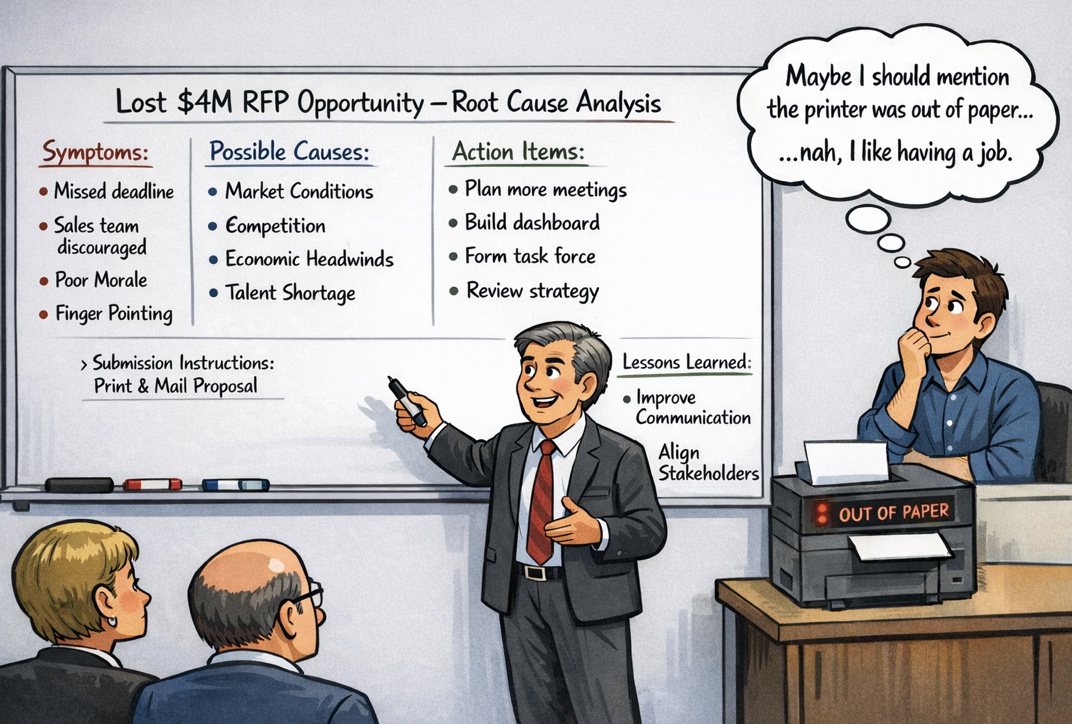
The whiteboard is full of bullet points. Heads nod thoughtfully. Comments are carefully phrased. At the end of the meeting, everyone leaves feeling productive. The problem has been addressed.
Until it happens again.
Sometimes in exactly the same way. Sometimes in a slightly different form. Revenue slips. Customers notice. Teams quietly develop workarounds. And the organization drifts into something dangerous: the appearance of problem solving.
Most organizations claim they want honesty. But hierarchy makes honesty complicated. Employees worry about appearing incompetent. Managers worry about challenging leadership. Executives worry about undermining confidence.
So when problems occur, organizations often ask the wrong question: Who caused this?
That question triggers defensive behavior almost immediately. People protect themselves. Information gets filtered. The real root cause disappears. What should have been learning becomes theater.
Great organizations handle this differently. They perform what some leaders call autopsies without blame — what Charlie Munger called a post-mortem.
The goal is not to identify a person responsible. The goal is to understand what allowed the problem to occur.
Instead of asking, Who made the mistake? they ask, What in our system made this mistake possible?
That shift changes everything. Because once people know they are not under attack, the truth begins to emerge. And improvement always begins with the truth.
At Hypora, we often approach these situations through a process we call Retro Mining.
The idea is simple. Start with the desired outcome. Compare it to the actual outcome. Then trace the path between the two.
We examine the customer journey, internal handoffs, and decision points that shaped the result. Sometimes the cause is obvious. Sometimes it takes deeper exploration. But one principle always guides the conversation: everyone involved did the best job they could with the information and systems available at the time.
That mindset removes fear. And once fear starts to disappear, honesty becomes possible.
Not every organization has a dramatic failure waiting to be discovered. But every organization has opportunities to improve.
And over time, small improvements compound. A one percent improvement in communication. A one percent improvement in process clarity. A one percent improvement in decision speed.
Individually, those changes feel small. Collectively, they begin to move the financials. But something even more powerful begins to happen: a cultural shift.
People start asking better questions. They challenge assumptions. They look for ways to improve the system instead of simply working around it.
Eventually momentum builds, because the message becomes clear: tomorrow’s standard must be higher than today’s.
At Hypora, we approach organizations with a simple philosophy: respect what has been built, respect who built it, and then strengthen it collaboratively.
Not by assigning blame. Not by introducing unnecessary bureaucracy. But by helping organizations see clearly.
Because when teams stop performing the ritual of problem solving and start confronting reality, something powerful happens. Improvement becomes inevitable.
Most of the time, the solution was already embedded in the knowledge of the workforce. It just needed the right environment to surface.